Table of Contents
AI has turned our world around like a bunch of balloons that got away from a three-year-old. Everyone is asking if we are on the verge of something that will change our world forever and can’t be changed back. I’m not talking about the whole world here, because it’s obvious that yes. Instead, I’m talking about the world of ecommerce. As the owner of an online store, I want to know if these changes will be advantageous or detrimental.
In my previous articles 5 ideas to use ChatGPT for your e-commerce store, Creating product descriptions with Chat GPT and other generative AI models. Testing Chat GPT, Hypotenuse, Jasper, Bing Chat, AI product image generator for your e-commerce store, I have described mostly the benefits of using AI. And what if, in all of our excitement, we didn’t notice that using AI content could cause our store’s ranking on Google to drop? Let’s look more closely at this question and see if using AI content can make us disappear from Google’s search results.
What’s the point of penalizing AI content by Google?
Before diving into the topic at hand, I figured it would be prudent to have the chat gpt’s opinion. Is it right to call it an opinion, or can LM have an opinion? But, despite that, this is the answer I got.

Google's aim is to provide its users with the most relevant and trustworthy information possible. Therefore, when it comes to AI-generated content, Google has the same standards and expectations as it does for human-generated content.
If the AI-generated content does not meet Google's standards for quality, relevance, and trustworthiness, it may be penalized, just as human-generated content would be. This can include being demoted in search results or even removed entirely from search results.
There are several reasons why Google might penalize AI-generated content, including:
Low quality: If the AI-generated content is low-quality, inaccurate, or contains errors, it may be penalized.Spammy content: If the AI-generated content is spammy, meaning it is designed to manipulate search results or mislead users, it may be penalized.Violations of Google's guidelines: If the AI-generated content violates Google's guidelines for webmasters, such as by using deceptive tactics or cloaking, it may be penalized.Lack of expertise, authority, and trustworthiness: If the AI-generated content lacks the necessary E-A-T (expertise, authoritativeness, and trustworthiness) to be considered a reliable source of information, it may be penalized.
Overall, the goal of penalizing AI-generated content that does not meet Google's standards is to ensure that search users receive the most accurate, helpful, and trustworthy information possible. By promoting high-quality content, Google can help ensure that users continue to trust and rely on its search results.
Ok, it doesn’t sound bad, isn’t it? So far, Google’s official position on using AI to write content is fine, as long as the content wasn’t written to change the search results. It doesn’t matter if a machine or a person wrote the content as long as it is useful, helpful, and good.
John Muller a webmaster’s messiah
But I have a feeling I shouldn’t trust the first best review. I was doing a lot of study on AI and was looking for anything that might be connected to what was being talked about on gpt chat, I found this tweet.

After that, I couldn’t stop. I went back and reviewed all of the articles and watched a lot of videos on material relating to SEO, Google and AI content. Even though I wasn’t very interested in Twitter (and I’m well aware that this is not a sin that can be forgiven), I taught myself how to use it. I felt like a geek, like a fan of Star Wars or Marvel, since little snippets of what filmmakers or CEOs said let me perceive the world as a full picture. You must be lost, then. Where am I going with this? Who is John Mueller, and what’s so important about his tweet?
John Mueller coordinates Google Search Relations efforts as a Search advocate. He has worked for Google since 2007, and the SEO industry knows him well. Mueller’s job at Google is to help website owners and writers understand how Google’s search algorithms work and to give advice on the best ways to use search engine optimization (SEO).
Mueller is active on social media and often answers questions from webmasters and SEO professionals during website hangouts and Q&A events. He is known for his careful and subtle approach to SEO and for being able to explain difficult technical topics in a way that a wide range of people can understand.
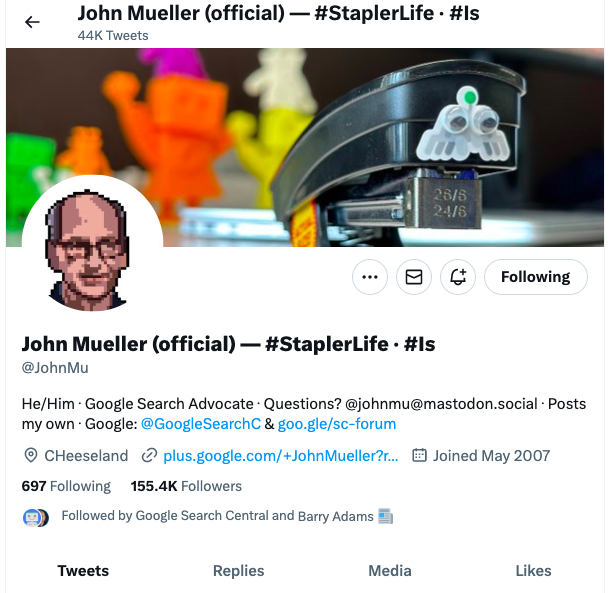
Mueller’s tweets can be very helpful for SEO experts and website owners (like me) who want to make their sites better for search engines. By watching Mueller on social media and reading his tweets, these people can keep up with the latest changes to Google Search and make sure they are using best practices that are in line with Google’s rules.
John Mueller’s tweet is meant to be an ironic answer to the question of whether or not to post content on a website using Chat GPT. Mueller’s answer says that even if 80% of the content made by Chat GPT is original, the other 20% could be hurtful or toxic to the people who use the website.
In sum, John Mueller’s tweet serves as a signal that, even though AI-generated content might be beneficial, it’s crucial to understand the potential risks and limits of this method, and to emphasize quality and user experience in content production for websites.
There are more Tweets by John Mueller about AI.
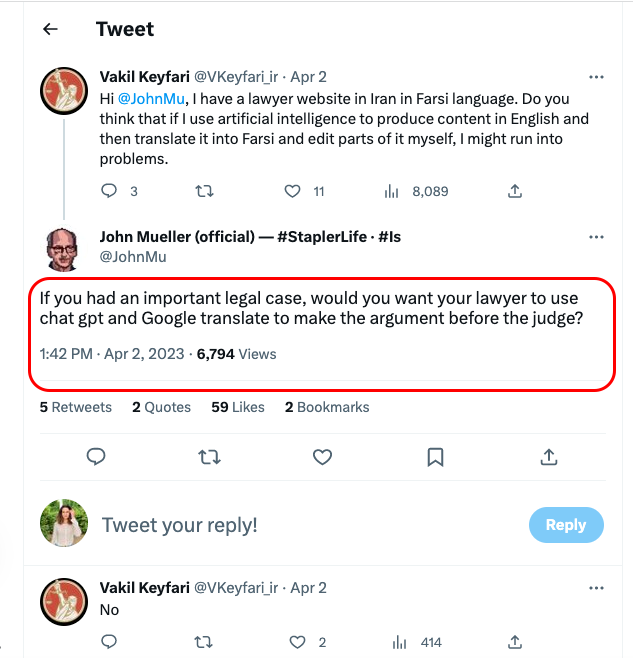
So what, you say? There was something said by an important person, but so what? Mueller’s posts and comments can help SEO optimizers learn more about how Google’s search engines work and how websites should be optimized for search. By reading Mueller’s posts and comments, SEO optimizers can keep up with the latest changes to Google search and make sure they are using best practices that are in line with Google’s rules.

What Mueller says and writes is like a service manual; I’m sure most people don’t read it, but they should. So his tweets and statements are instructions to webmasters: pay attention to what I say or you will be banned by Google.
Google has a history of punishing websites that have low-quality or auto-generated content.
Google has always punished websites with low-quality material or content that AI generated. To put it simply google penalized AI content. It uses this method because it wants to give its people information that is useful, accurate, and important. Websites with material that doesn’t make sense, is copied from somewhere else, or is made automatically without human input are thought to be of low quality.
For example, in 2011 came out The Google Panda update, which was meant to improve search results by punishing websites with low-quality or thin material. It had a lot of effects, like dropping the rankings of sites with bad content and raising the rankings of sites with good content. The change stressed how important it is to have high-quality, relevant content and a good user experience. This made website owners realize how important it is to have unique, useful content. The quality of the content is still an important part of SEO, which is in line with Google’s focus on providing useful and trustworthy search results.
With the rise of advanced AI models like ChatGPT-4, SEO scammers might be able to make a lot of content that looks like it’s original and makes sense. This makes it hard for search engines and SEO experts to keep content quality high and keep users’ trust. To fix this, search engines are always improving their algorithms to find low-quality or fake content and screen it out. This includes content made by AI. SEO experts should focus on making content that is useful, relevant, and geared toward the user in order to build trust and give the user a real experience.
As AI technology improves, search engines, like Google, will continue to improve their algorithms. This will make sure that search results highlight useful material and keep the search environment working well.
Content that isn’t original, relevant, or correct is said to be of low quality. It can be thin content that doesn’t add much value, content that is full of buzzwords or information that isn’t relevant, or content that was made only to manipulate search engine results. On the other hand, AI generated content is made by algorithms or software programs without human input or supervision.
Google has come up with complex algorithms and human quality checks to find websites with low-quality or automatically-generated content and punish them. Websites that do these things may see their search engine scores drop significantly or even be pulled from Google’s search results. This is done to make sure that when people look, they get good information they can trust.

Google’s fines are a barrier that makes website owners less likely to use tricks to get better results. Instead, Google tells authors to focus on making content that is original, useful, and focused on the user, and that follows Google’s rules. By doing this, website owners can improve their chances of showing up high in search results and give users a good experience.
It’s important for website owners and content makers to put quality, relevancy, and validity at the top of their lists when making content. This will help them avoid getting penalized by Google and give users the useful information they’re looking for.
Any website that goes against Google’s Webmaster Guidelines, including those with content made by AI, can get a penalty. A website can get a penalty if it is found to have broken the rules by using AI-generated material that is low-quality, spammy, or breaks copyright laws. For example sites can be simply removed from index or got shadow banned. Many SEO experts say that it’s easier to start a new site after that.
When a website violates the Webmaster Guidelines or uses deceptive strategies to boost its search engine ranks, a Google human reviewer issues a manual penalty, also known as a manual action. But it’s quite rare now so in most cases you will have algorithmic penalties.
Unlike Google’s algorithm-based punishments, these fines are based on a thorough website inspection. Spammy link building, keyword stuffing, content manipulation, and other infractions lead to punishments. Penalties enforce Google’s quality standards and provide consumers with trustworthy material.
Google Search Console notifies website owners of penalties and provides instructions for fixing them. Penalties may be difficult and time-consuming, but website owners must fix the flaws, follow Google’s instructions, and file a reconsideration request to recover search visibility and reputation.
However, bear in mind that Google’s penalties aren’t limited to AI content. They are given out for breaking Google’s rules, no matter what method was used to make the content. The goal of a human punishment is to enforce quality standards and make sure users have a good time, no matter what method was used to make the material.
Google and AI content. Is it safe to use AI creating tools?
While AI technologies have made great progress in content generation, depending only on them may not ensure the development of high-quality and relevant information for users. I’ll give you 5 reasons to prove my point:
- Lack of understanding of the context: AI tools work mostly by looking for trends and analyzing statistics. They don’t understand the subject well enough or in the right context. So, they might come up with content that is scientifically correct but lacks the details, depth, and subtleties that make for a meaningful and informative reading experience.
- AI tools are very good at imitating known patterns and making content based on models, but they can’t do the same for human creativity. They often have trouble with creative thought, insight, and coming up with new points of view. Quality content often needs to be original, have new ideas, and have a human touch, which can be hard for AI to copy.
- Limited Emotional Intelligence: To write content that is interesting and convincing, you need to make readers feel something, connect with them on a human level, and understand their needs and wants. Since AI tools don’t have emotional intelligence, they may not be able to make material that connects with viewers or makes them feel the way they want to.
- Plagiarism or unoriginal content could happen because AI models are taught on a huge amount of current data, like books, papers, and websites. There is a chance that the content that is created will look too much like other works, which could be considered theft or content that is not original. This can hurt the content’s confidence and creativity, both of which are important parts of good content.
- Subjectivity and reading: Good content often needs a biased reading of information, taking into account different points of view, biases, and cultural differences. AI tools might find it hard to deal with this complexity and make material that is both complete and well-rounded, especially in areas where human views or subjective analysis are important.
AI tools can be helpful for coming up with first drafts or making ideas, but if you only use them to make content, it might not have enough depth, relevancy, or quality. When AI is combined with human knowledge and editing judgment, the end content is more likely to meet the needs and demands of the readers.
What to avoid when using AI-based content creation tools?
There are a few things to watch out for when using AI-based content creation tools if you want to keep the quality of your content high and make sure it works well. Here are some key things to think about.
Don’t accept content made by AI that hasn’t been carefully checked and edited. Always look over the results and make changes to make sure they are correct, make sense, and meet your needs. AI-made content can be a starting point or a source of ideas, but it shouldn’t be released without being checked by a person.
AI models might not fully understand the context or tone that your material needs. Make sure to give the AI tool clear rules and instructions about the content’s purpose, intended audience, tone, and style. Review the results and change them so that they meet your needs.
AI models are taught on a huge amount of data that already exists (I already wrote about it above), which can lead to content that looks a lot like other works. Take care to check the content that is created for copying and make sure it is unique. Use tools that find copying and do thorough reviews to keep your work original and trustworthy.
AI tools can help make content, but they don’t always have the creativity and originality of human writers. Don’t depend only on material made by AI for projects that are artistic or unusual. Instead, use the imagination of people to give your material fresh ideas, new views, and a personal touch.
AI models might not fully understand how to connect with and engage an audience’s emotions. Make sure that the content created by AI tools is reviewed to see if it can connect and resonate with your target audience. Change what needs to be changed to create content that makes your readers feel the way you want them to and gets your message across.
AI technology is changing quickly, and new tools and models are being made all the time. Stay up-to-date on the latest changes to AI-based content creation tools so you can take advantage of better quality, more accurate results, and more ways to customize your content.
Remember that AI tools should be seen as helping humans be more creative and productive, not as replacing human brain and judgment. By being careful, regularly reviewing and changing AI-generated content, and mixing it with human knowledge, you can get the most out of AI while still keeping control over the quality of your content.
Google EEAT as a tip on how not to get banned.
There is a dramatic rise in Google’s user base every single day. As a result, search engine optimization (SEO) has become crucial for acquiring online renown and recruiting new clients. Some participants started gaming Google’s search results by strategically over-optimizing their site to boost their page rankings and attract visitors.
That is why Google implemented algorithms such as E-A-T and YMYL. E-A-T, which stands for Expertise, Authority, and Trustworthiness, was a key SEO (Search Engine Optimization) idea that Google used to judge the quality and usefulness of web content. It has given us a way to judge how trustworthy and reliable a website and its content were.
Google uses EAT to make sure that the pages people see are reliable and give a fair assessment of the problem. This kind of content gives the search engine faith that users will get the best results that answer their most pressing questions.
YMYL stands for Your Money or Your Life. This Google algorithm prioritizes information crucial to consumers’ economic security and quality of life. First, this refers to content that directly threatens users’ lives and health. Imagine you are looking for expert medical advice on how to treat your back pain, but the top search engine only shows you spammy pages with questionable advice that isn’t based on any scientific research. Some users will find this very annoying, but others will believe this information is true and use it as part of their treatment, which can have deadly results.
Google uses this technology to find material that is important to users’ jobs or their general well-being. Like in the first case, fake or low-quality material in this area can do a lot of damage to people. When Google finds that a query is YMYL, it gives greater weight to the E-A-T signals, which show that you are acknowledged as a reputable source of information on this issue.
So, you might ask, what is the point of the EEAT? Google made changes to the EAT algorithm in December 2022 and added a new factor: Experience.
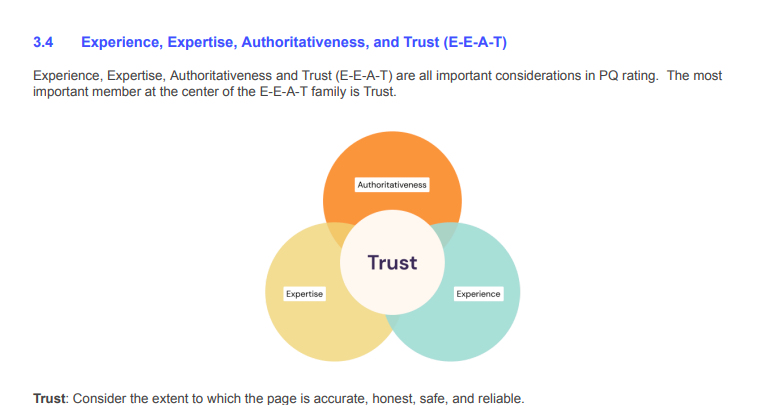
EEAT is an acronym that stands for Experience, Expertise, Authoritativeness, and Trustworthiness. These are all important factors when it comes to the quality of content and SEO.

Does the contents also show that it was made with some kind of experience, like actually using a product, having been to a place, or telling what a person went through? In some cases, the most valuable information is that which comes from someone who has lived experience with the subject at hand.
For example, you might want to know how to fill out the right paperwork to get insurance or make an appointment with a doctor. In such cases, the most valuable information is that which comes from someone who has lived experience with the subject at hand.
Experience, Expertise, and Authoritativeness may combine for some page types and topics (for example, a person may become an Expert in a topic by learning about it firsthand over time), and different mixtures of E-E-A may be important for different subjects. You should think about the page’s purpose, type, and subject, and then ask yourself what makes the page’s author a reliable source in that situation.
The most important part of the E-E-A-T family is Trust, because pages that aren’t trustworthy have low E-E-A-T, no matter how Experienced, Expert, or Authoritative they seem. For example, a financial scam is not reliable, even if it was made by a very experienced and skilled con artist who is known as the go-to person for running scams!
Putting everything together, it’s clear that AI material might not meet the E-E-A-T requirements. And Google might ban sites that use it, or put it on a list of sites that are banned. And some experts say it’s easier to fly to the moon than to get out of Google’s shadow ban.
Change in plans: Google now approves AI content
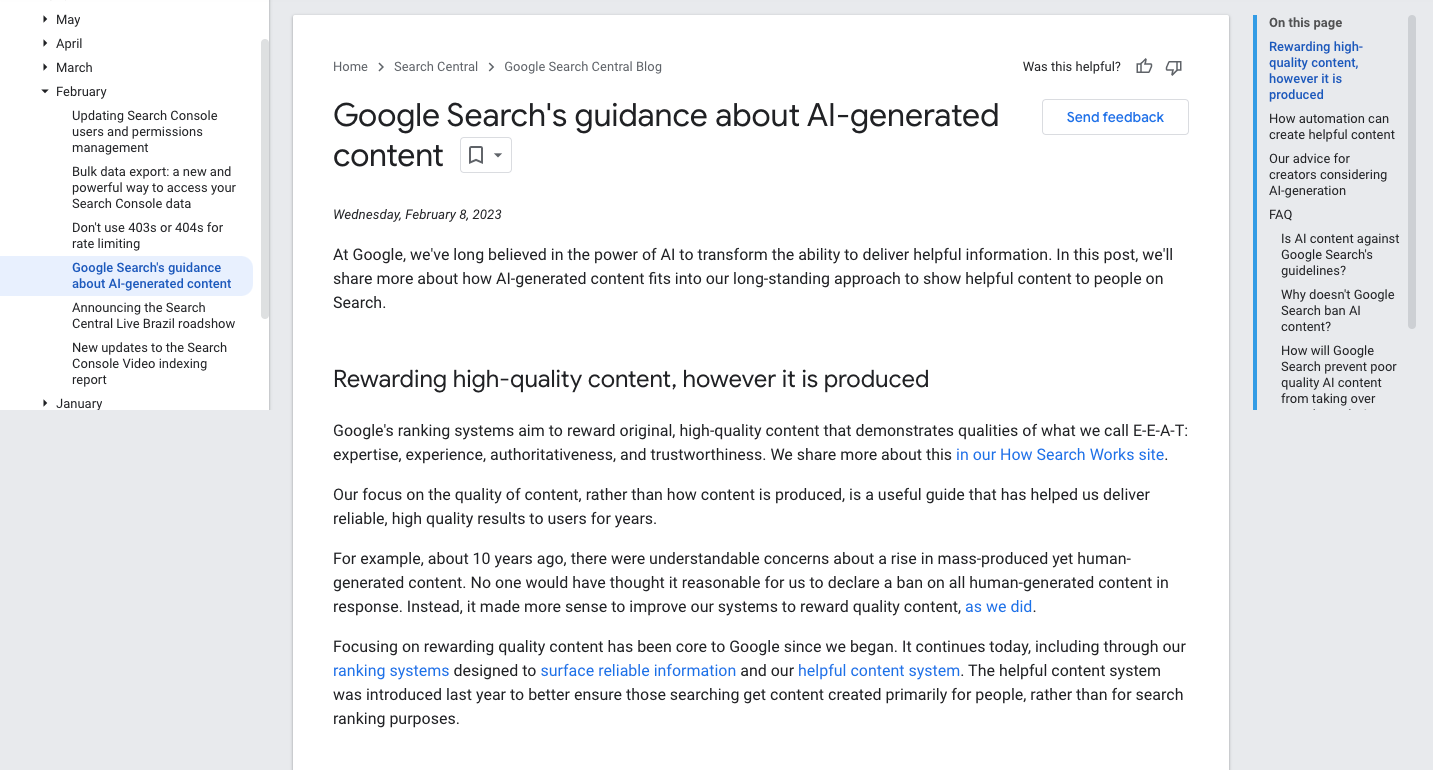
Well, Google made it clear that anything made by artificial intelligence would be considered spam until 2023. But it changed its mind. It’s not clear if this was because of public opinion or because of competition in the AI market, but on April 8, 2023, the company said that AI content will now be treated like any other.
What does it mean? Automation and artificial intelligence can be used in the right way, which is not against Google rules. This means that it is not used to make content mainly to change search ranks, which is against Google spam policies.
You let out a sigh of relief, as if I shouldn’t be able to take it easy yet. Let’s see if it’s really what it seems to be.
The short version is that the rules for Google Search don’t directly ban material made by AI. Google will instead recognize “high-quality content, no matter how it is made.” “High-quality content” is defined by the company as “expertise, experience, authoritativeness, and trustworthiness,” or “E-E-A-T.”
Google won’t straight punish AI-made content, but it says that using AI to make content with the “primary purpose of manipulating ranking in search results” is still against its rules. However, not all uses of automation are considered spam.
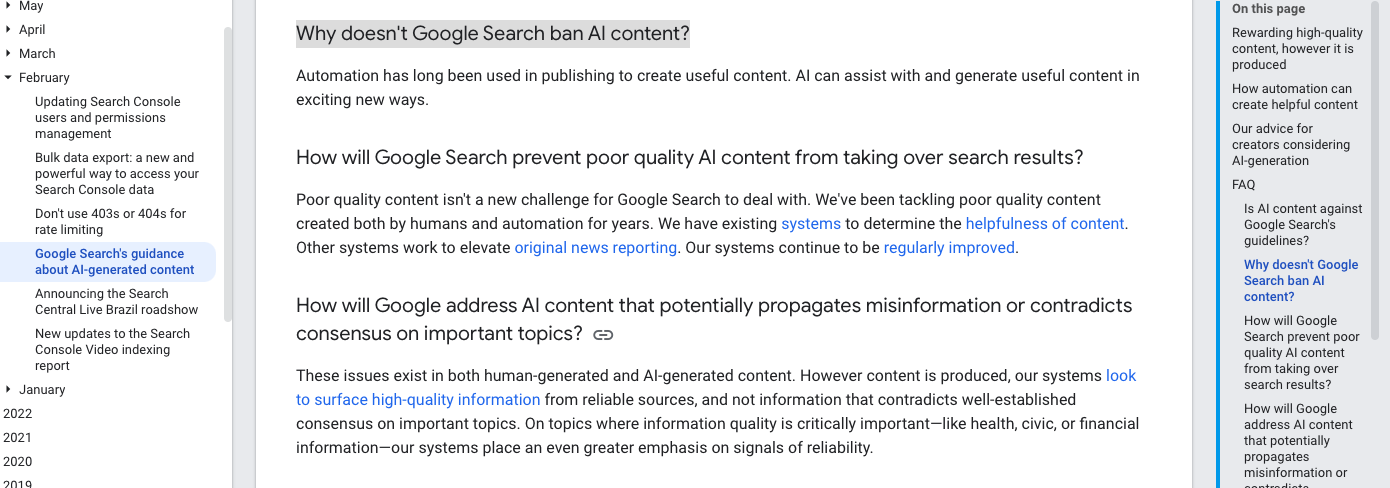
Google has a number of tools, like SpamBrain, that look at trends and signs to help us find trash content, no matter how it is made. Poor quality material is not a new problem for Google Search. For years, it has been dealing with low-quality material generated by both people and machines. And it is no longer difficult to identify AI-generated low-quality material.
What conclusion can we draw? The perception of AI has changed, particularly in the context of content generation and text. We can definitely say that AI is no longer seen as something to avoid, and Google is no longer against material made by AI. It also says that Google is reminding everyone to focus on information that is made for people.
Before, there has been skepticism and concern about the use of AI in generating content, because they thought it might decrease the quality and accuracy of the information. But Google’s position has changed, which shows that it is becoming more open to AI-generated material under certain conditions.
By saying again and again how important it is to write content for people, Google seems to be saying that even though AI can be a useful tool for creating content, it should still give priority to content that is written for people and is relevant, helpful, and interesting to users. This seems to show that Google recognizes AI’s promise but wants content authors to think about what human readers want and need.
It’s important to note that while Google’s statement gives an interesting point of view, it’s always a good idea to keep up with the latest information from dependable sources, as rules and policies about AI and content generation may change over time.
Google friendly AI content, how does it look?
Based on the fact that Google now interprets AI content as well as human-created content, we can clearly state that all high-quality content production is relevant. I already told you how Google thinks, algorithm E-E-A-T and YMYL up above. But it is not only this that influences your position. Google’s automatic ranking systems are set up to put in the top Search results helpful, reliable information that was made to help people and not just to get higher search engine ranks. You have to create helpful, reliable, people-first content.
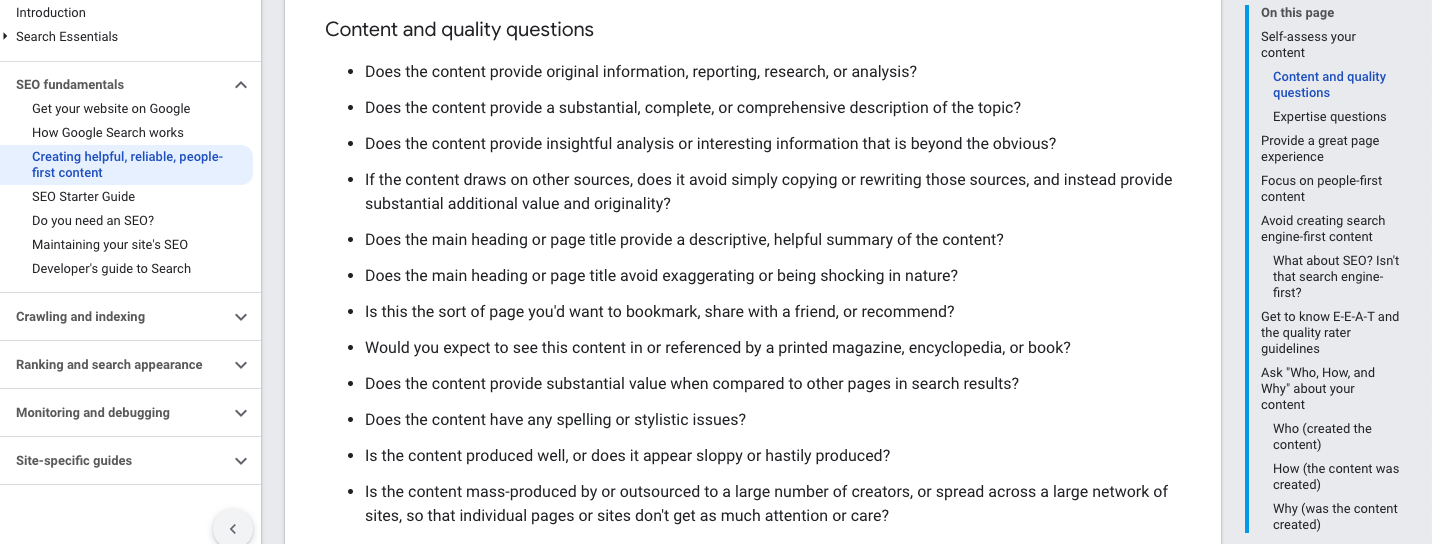
Google makes a list of questions that you can use to evaluate both your content and figure out if it is useful and reliable.
Additionally, you have to provide great page experience. Google’s main scoring methods try to give points to pages that have good information. If site owners want to use Google tools well, they shouldn’t just focus on one or two parts of page experience. Instead, you should check to see if your page is good in many ways as a whole.
And it is also very important to create content for people. People-first content is content that is made for people and not to trick search engines into giving it a higher rating. You must have noticed that when you use Google to look for something, you end up on a page with a lot of trash materials. This is an SEO page that attracts visits from search engines. Such pages put out a lot of content on a wide range of topics in the hope that some of it will do well in search results. Of course, Google is always trying to find and get rid of these pages. And makes it clear that it only cares about material that is for people.
Always is good idea to check Search Engine Optimization (SEO) Starter Guide. This is a source of knowledge that is helpful. Don’t ignore it, and it will help you figure out what you’re doing wrong or what you need to do in this or that situation. Even if you hire a consultant to help with your SEO, you should still know what’s going on.
Ok, and the last one – the formula “Who, How, and Why”. You may consider looking at your content in terms of “Who, How, and Why” as a way to stay on track with what Google’s systems want to credit. And here is the catch for AI content, because “Who” means who created the content. When it’s clear who made the material, people can understand its E-E-A-T more easily. This is the “Who” to think about.
We need to look at this more closely if we want to explain it. Is it clear to your site users who wrote the content? If you make it clear who made the material, you’re probably in line with the ideas of E-E-A-T and on the right track to success.
Google strongly encourages adding correct source information, like bylines, to content where readers might expect it. If we use AI to write a description of a product, we probably don’t need to sign it. If we have a blog where we promote our products, people will want to know who wrote it.
The next part of the formula is “How”. Google believes that readers find it helpful to know how a piece of content was made. This is the “How” you might want to include in your content.
For example, users are more likely to believe a product review if they know how many products were tried, what the results were, and how the tests were done, and if there is proof of the work, like a picture, to show that it was done.
“How” can be a part of a lot of different kinds of content. This can include material that is automatic, made by AI, or helped by AI. And this is where the question comes up: If you write a review for your store’s goods, which I’m sure everyone does, does that break the E-E-A-T rule if you use AI to write it? Definitely, yes.
And the last part but not least “Why”. It is probably the most important question to answer about your material. Why is it being made to begin with?
The “why” should be that you’re making content to help people, useful content for people who come straight to your site. If you do this, you’re in line with E-E-A-T and what Google’s core search systems look for and try to encourage.
If the “why” is that you’re mostly making content to get people to come to your site through search engines, that’s not what systems are set up to reward. Google spam policies say that you are breaking the rules if you use automation, including AI-generated content, to make content with the main goal of changing search results.
Final thoughts
Wow, how much new information I poured out on you and what to do now. Summarizing the above, what conclusion can we draw specifically in our case? As an online store in any field, we are directly dependent on Google, as it sends us traffic. We cannot ignore his policy as it directly affects our sales. Of course, you need to become independent and draw traffic from various sources. I’m all for it, but we don’t always have such an opportunity.
What I can say for sure about Google and AI content is that AI materials might not follow the E-E-A-T principle, and if a page uses this kind of content, its rank will go down. But let’s think about which page of our website is most significant to our store and where we can use AI content. Of course, this is the product page.
But Google doesn’t care about our product page or any other product page because it doesn’t think it has much weight. It shares information based on how useful, trustworthy, experienced, or authoritative it is. And online shops that have pages for their products don’t quite fit on this list.
So, whether or not you use AI material to describe your goods, it probably won’t change where your product page ranks. Of course, this doesn’t mean you should put AI content on your product page without any human oversight. It doesn’t matter who wrote the description as long as it fits the object being sold.
Вut If you run a blog and sell your goods on it, that’s a whole different story. Because Google sees each post differently, this blog and the posts on it really bring you traffic. And here, using AI tools can be important for E-E-A-T, especially when it comes to expertise and experience. Especially if you put your name on it as the author, like I did on https://ediy.io/.
Last but not least, I want to draw your attention to the fact that optimizing the product page or the main page should be part of your marketing plan, no matter if these pages are more important or not. Even if it doesn’t, Google’s system should show people the goods they’re looking for. This means that your product can be the one that might be shown.
I will use John Mueller’s case to back up what I say. Remember John Mueller – this is the “Google guru”. In one of his broadcasts, a user asked him what he noticed that product pages were not ranking well on Google. To which Muller replied that ranking product pages is a difficult task, but if those pages are not promoted it will be difficult to achieve a higher ranking. Here is a link to the stream, namely the specific conversation.

To sum up yet again, Google won’t penalize your AI content just because it was made by AI, as long as it’s good quality, and its connection to it will be the same as to content made by people. But Google’s ranking rules suggest that AI material that doesn’t follow the EEAT can definitely be lowered. Google wants and will reward people who write high-quality material on their own. And it’s possible that this material will be the most important part of the issue in the future, especially in highly competitive areas.